
Forest Hill Restoration Services
Restoration for Forest Hill estate homes, apartment buildings, schools, and village businesses, with the loss documented from the first inspection.
Firstline Restoration provides 24/7 Restoration in Forest Hill and across the GTA. We respond within 45 minutes, mitigate the damage, and document everything for your insurer, licensed, insured, and WSIB-covered.
Request Help in Forest Hill
Calling is fastest for active emergencies. 45-min emergency response · free assessment · we work directly with your insurance.
Tell us what happened in Forest Hill
Calling is fastest for active emergencies. 45-min emergency response · free assessment · we work directly with your insurance.
Licensed and Insured Restoration Support
One Firstline project file connects the emergency work, moisture and damage records, insurer communication, contents decisions, and the repair scope.
Restoration Planned for Forest Hill Property
Forest Hill is not one building type. It includes 1920s to 1950s estate houses, designated heritage properties, walk-up apartments, rental towers, townhouses, schools, and the mixed-use buildings of Spadina Road.
A loss on Old Forest Hill Road may involve plaster, stone, custom millwork, and concealed cavities assembled over several renovation eras. A leak on Lonsdale Road can move through stacked suites before it becomes visible. A fire near the Lower Village can interrupt apartments above a shop as well as the business below. Firstline begins by identifying the source, the affected assemblies, the occupants, and the access limits, then builds the emergency and repair scope around that Forest Hill property.

response time

What Forest Hill Restoration Services Cover
Firstline handles urgent stabilization and extraction, followed by building drying, contaminated-water cleanup, fire residue work, mould remediation, selective removal, contents recovery, odour treatment, weather protection, and reconstruction. The service applies across Forest Hill South, Forest Hill North, the Lower Village, the Upper Village, and the apartment corridors near St. Clair Avenue West, Bathurst Street, and Eglinton Avenue West. The work is adjusted for detached houses, shared residential systems, institutional campuses, and mixed-use buildings instead of forcing each loss into one standard package.
Water Losses Above a Buried Creek System
Old Forest Hill Road follows the historic Forest Hill stream, a tributary of Castle Frank Brook that now runs largely through buried storm infrastructure. Cedarvale Ravine still reveals the grade that shaped the old drainage route. That history does not mean every address is in an open floodplain, but it does make topography, sewer connections, lot drainage, and foundation condition important during a basement investigation. Toronto has planned sewer improvements on Dunvegan Road, Forest Hill Road, and Frybrook Road through its basement flooding program. Firstline therefore looks beyond visible floor water to wall bases, finished cavities, storage rooms, sump equipment, foundation cracks, and the route by which water reached the house.

Older Houses Need Selective Investigation
Forest Hill's large houses often combine original masonry and timber with later additions, finished lower levels, upgraded mechanical rooms, built-in cabinetry, and integrated lighting or control systems. Water can follow a beam pocket, pipe chase, or old opening without producing a clean stain directly below the source. Smoke can settle inside plaster cracks, millwork, return-air pathways, and roof voids. Broad demolition can destroy materials that could have been dried, cleaned, or matched. Firstline uses moisture mapping, photographs, room-by-room records, and controlled openings to establish the actual boundary of damage before removal expands.
Heritage status is checked rather than assumed. A designated house or a property with significant original fabric may need a repair sequence that preserves masonry, windows, trim, and streetscape character. A postwar house in the Upper Village presents a different assembly and can often move through drying and reconstruction more directly. That distinction is made at the address, not from the postal code alone.


Water, Sewage, and Mould in Finished Basements
Toronto identifies heavy rain, snowmelt, failed foundation drainage, poor grading, tree roots, blocked laterals, and overwhelmed sewers as common basement-flood causes. Forest Hill adds mature lots, deep basements, old foundations, and expensive finished rooms to that picture. Clear seepage, a sanitary backup, and a failed supply line require different containment and disposal decisions. Firstline documents the source category, removes standing water, protects unaffected rooms, checks behind finishes, and tracks drying readings until the affected structure is ready for repair.
Mould work starts with the moisture source. In an older house that may be a slow plumbing leak behind plaster, condensation in a renovated cold room, an attic ventilation problem, or incomplete drying after earlier seepage. In an apartment it may be a riser, roof, window-wall, or suite-to-suite leak. Containment, removal, air control, cleaning, and repair planning are sized to the affected area and occupancy. A visible patch is not treated as proof that the full problem has been found.

Fire, Smoke, and Firefighting Water
A Forest Hill fire loss can cross several material generations in one building. Soot may affect an original wood stair, a renovated kitchen, a high-efficiency mechanical system, and stored contents in the same event. Firefighting water can travel below the burn area and create a second loss in ceilings, walls, and lower floors. Firstline separates immediate board-up or weather protection from the detailed cleaning and repair scope. Rooms are photographed, contents are triaged, odour pathways are identified, and unstable materials are isolated before cleanup proceeds.
For apartments and mixed-use buildings, the plan also addresses corridors, elevators, shared ventilation, neighbouring suites, and tenant access. A kitchen fire above a Spadina Road storefront affects business continuity and residential safety at once. A mechanical or electrical fire in a rental building near Bathurst Street requires records by common area and suite so the owner, residents, and adjuster can follow what was affected and what remains usable.
Apartment Buildings Are a Core Forest Hill Property Type
Forest Hill North is dominated by apartments in buildings of five or more storeys, while Forest Hill South combines towers, walk-ups, condominiums, and detached houses. A vertical water loss can involve the source suite, several ceilings below it, common risers, electrical rooms, storage lockers, and finishes that vary from unit to unit. Firstline coordinates access with the property manager, protects elevators and corridors, labels readings and photographs by suite, and separates corporation work from owner or tenant contents. This creates a usable record for a condominium board or rental owner instead of one undifferentiated loss file.

Contents and Finishes Need an Early Decision
Estate properties around Dunvegan Road, Russell Hill Road, Forest Hill Road, and Old Forest Hill Road may contain custom cabinetry, hardwood, stone, art, books, wine storage, rugs, and furniture that cannot be treated as ordinary debris. The first hours are used to move dry contents away from the loss, photograph room context, identify items needing specialized handling, and create a chain of records for pack-out or on-site protection. Salvage decisions are made by condition and material. The repair plan then accounts for matching, lead times, and the interfaces between retained finishes and new work.

Schools, Main-Street Businesses, and Institutional Property
Upper Canada College, Bishop Strachan School, nearby places of worship, professional offices, restaurants, and Forest Hill Village shops bring occupancy and scheduling issues beyond residential drying. A school loss may involve classroom access, archives, gym or food-service spaces, and work that must be isolated from students. A village business may need a safe public route and a plan for stock, equipment, and reopening. Firstline sets work zones, records affected assets, and sequences noisy or disruptive tasks around the building's use where conditions permit.

How a Forest Hill Loss Moves From Call to Rebuild
- Confirm the address and building type. Dispatch planning distinguishes an estate street, a ravine-edge lot, an apartment loading area, and a Spadina Road storefront before the crew arrives.
- Control immediate hazards. The source is stopped where possible, unsafe rooms are isolated, and openings, roofs, or plumbing are temporarily protected.
- Map the spread. Photographs, moisture readings, affected-material notes, and suite or room labels establish where the loss travelled.
- Protect what remains. Floors, millwork, contents, elevators, and unaffected rooms are separated from traffic and demolition dust.
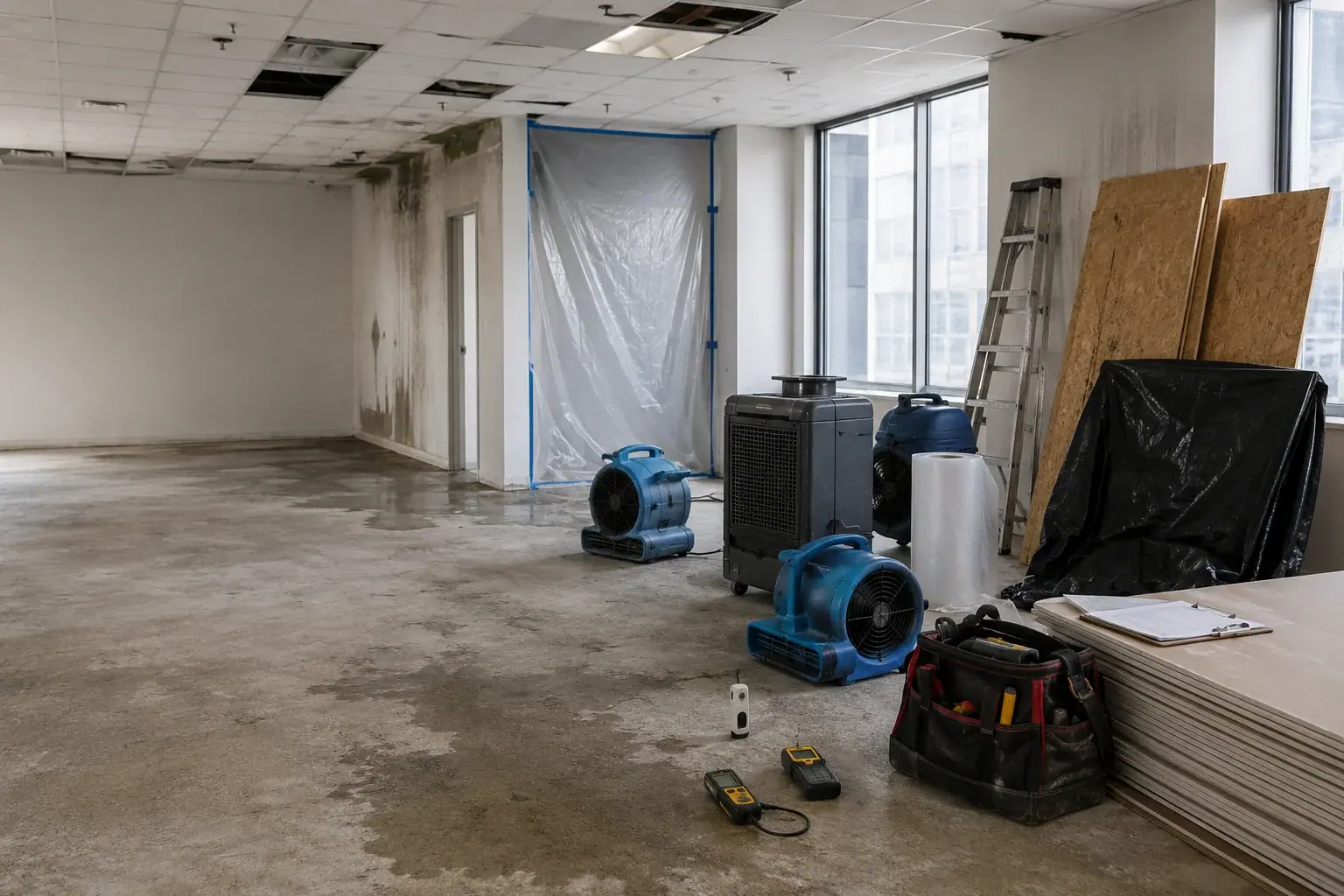
- Mitigate and monitor. Extraction, removal, cleaning, air control, and drying equipment are adjusted as readings change.
- Build the repair scope. Retained materials, matching needs, heritage considerations, code work, and finish interfaces are recorded before reconstruction.
- Complete and hand over. Repairs, cleanup, final review, and project records close the gap between emergency work and a usable property.
Claim Documentation for High-Detail Losses
Insurance decisions depend on the policy and the insurer. Firstline does not promise coverage. It documents the cause observed on site, emergency measures, affected rooms, moisture conditions, contents handling, controlled removal, and the proposed repair scope.
That record gives the adjuster a clear account of why work was required and helps prevent original plaster, custom trim, apartment finishes, or concealed damage from disappearing into a vague allowance. Project records are shared with the assigned adjuster, and insurer-approved direct billing can be arranged. The property owner remains responsible for the deductible and any work outside approved coverage.
Access Planning Inside Central Toronto
Forest Hill is close to the Toronto core, but distance is not the main access issue. Bathurst Street, Avenue Road, St. Clair Avenue West, and Eglinton Avenue West carry heavy traffic. Interior roads curve around old topography, parking narrows the curb lane, ravine grades can complicate equipment movement, and apartment work depends on loading and elevator windows. Firstline plans the hose route, equipment staging, floor protection, and waste path so the response does not create a second problem in finished common areas or on a landscaped estate lot.
One Accountable Team for Forest Hill Restoration
Damage in Forest Hill? Call Firstline Now.
Keep people away from unsafe water, smoke, loose ceilings, and electrical hazards. Then call (416) 900-3508 so the property, access conditions, and immediate risks can be assessed.
Photos are useful when they can be taken safely, but do not delay an emergency call to collect them. Firstline can begin the record on arrival and coordinate the next steps with the owner, manager, or adjuster.
Need restoration in Forest Hill now?
Talk to Firstline Restoration, 24/7 emergency response, insurance claim support, and full reconstruction.
Companies We've Worked With
Trusted by Leading Organizations
Firstline Restoration serves commercial, institutional, and property-management clients across the GTA.










Forest Hill Restoration Services FAQ
Do you handle both Forest Hill houses and apartment buildings?
Yes. The response is adjusted for estate houses, postwar homes, walk-ups, rental towers, condominiums, schools, businesses, and mixed-use property. Apartment documentation is organized by suite and common area.
Why does Cedarvale Ravine matter to a restoration assessment?
The ravine preserves part of the topography associated with the buried Castle Frank Brook system. It makes grade, runoff direction, old drainage routes, and foundation conditions relevant, although it does not place every Forest Hill address in an open floodplain.
Can original plaster and woodwork be saved after water damage?
Sometimes. The decision depends on contamination, saturation, attachment, finish condition, and whether the assembly can be dried. Firstline uses controlled openings and readings before deciding what must be removed.
How are condominium losses documented?
Readings, photographs, work notes, and affected materials are labelled by suite, corridor, riser, storage area, or other common element. That helps the corporation, unit owners, tenants, and adjuster understand separate portions of the loss.
Do you work with heritage properties?
Firstline identifies designated status and significant original materials during scoping. Repair planning can then account for salvage, matching, selective removal, and any municipal approval that applies to the property.
Can Firstline communicate with my insurer?
Yes. Firstline prepares the damage record and scope, communicates with the adjuster, and can arrange direct billing where the insurer accepts it. Coverage and the deductible remain subject to the policy and insurer decision.
What should I do after a sewage backup?
Keep people and pets out of the affected area, avoid using plumbing if that could worsen the backup, and call for help. Do not move contaminated contents through clean rooms unless directed.
Which Forest Hill areas do you serve?
Firstline serves Forest Hill South, Forest Hill North, the Lower Village, the Upper Village, and properties near Cedarvale, Chaplin Estates, South Hill, Casa Loma, Wychwood, and Humewood.
Request Restoration Help in Forest Hill
Call Firstline Restoration 24/7/365 for emergency stabilization, damage documentation, cleanup, and reconstruction.
Describe the property type, the source if known, and any access or occupant concerns so the response can be prepared for the building.
Request Help Now
Calling is fastest for active emergencies. 45-min emergency response · free assessment · we work directly with your insurance.
Restoration Near Forest Hill
View all service areas →Firstline Restoration provides 24/7 emergency response for restoration across Toronto and surrounding Ontario communities.