
Ancaster Restoration Services
Property restoration across an Escarpment community of heritage village buildings, suburban neighbourhoods, rural systems, and a major business park.
Firstline Restoration provides 24/7 Restoration in Ancaster and across the GTA. We respond within 45 minutes, mitigate the damage, and document everything for your insurer, licensed, insured, and WSIB-covered.
Request Help in Ancaster
Calling is fastest for active emergencies. 45-min emergency response · free assessment · we work directly with your insurance.
Tell us what happened in Ancaster
Calling is fastest for active emergencies. 45-min emergency response · free assessment · we work directly with your insurance.
Restoration Records for Urban and Rural Ancaster
One project file connects the source, water or residue route, protected contents, equipment readings, insurer communication, and final repair.
Ancaster Requires More Than an Upscale-Suburb Assumption
Ancaster spans an old village, the Niagara Escarpment, postwar housing, Meadowlands growth, farms and rural estates, Redeemer University, and a 660-acre employment park.
A stone building near Wilson Street does not share its assembly with a new townhouse on Garner Road. Mineral Springs and Sulphur Springs properties may sit near steep valleys or private services. A food-production loss on Cormorant Road has operational controls that do not exist in a detached home.
Firstline verifies the address, building use, water and wastewater system, access, and affected materials before setting the response. That prevents urban assumptions from being carried into a well and septic property, or residential methods from being imposed on an operating plant.

response time

What Ancaster Restoration Services Include
Service can begin with source control, pumping, temporary roof protection, safety isolation, and contents movement. It may continue through structural drying, contaminated-water removal, soot cleaning after fire, smoke-odour work, mould remediation, selective demolition, and reconstruction. Firstline works in Ancaster Village houses, Meadowlands condominiums, Oakhill and Mohawk Meadows homes, rural buildings, student or seniors housing, retail, schools, churches, warehouses, and production facilities. The loss is divided into practical zones and phases, with evidence guiding what is cleaned, retained, removed, monitored, or assigned to a specialist.
Ancaster Creek, Tiffany Creek, and Sulphur Creek Cross the Escarpment
Ancaster Creek and Tiffany Creek feed Sulphur Creek, which then reaches Spencer Creek and Cootes Paradise. Their headwaters lie above the Escarpment, while valleys, waterfalls, groundwater discharge, and culverts move water toward lower terrain. The Ancaster Creek subwatershed extends from Fiddler's Green Road toward Southcote Road and includes highly developed surfaces alongside sensitive natural areas. A basement event near a valley therefore requires source tracing, not an automatic flood label. Firstline distinguishes supply water, sanitary material, surface runoff, groundwater seepage, and roof entry. Moisture is checked at wall bases, under flooring, behind cabinets, and along floor levels that step with the grade.

Village Heritage Calls for Selective Investigation
Ancaster's pre-Confederation inventory identified dozens of early properties, adding 56 to Hamilton's register. Wilson Street and adjoining village roads contain stone, brick, frame construction, plaster, timber, old foundations, and adaptive reuse. A fire or leak can move through an original assembly and a modern addition before appearing in a finished room. Firstline documents the construction sequence and opens only enough to identify damage and create safe drying or cleaning access. Stone walls, old mortar, heavy timber, wood windows, and original trim are evaluated separately from replaceable finishes.
Heritage status is confirmed at the address. The repair plan can then preserve viable material and coordinate any exterior approval rather than treating age alone as permission for unlimited removal.


Municipal Service Ends Before the Ancaster Name Does
Urban Ancaster receives treated Lake Ontario water through Hamilton's central system and sends wastewater toward the Woodward network. The city has also addressed pressure and storage needs through an elevated reservoir plan. Rural roads and settlement areas can instead rely on private wells, cisterns, septic systems, propane, or oil.
A sewage incident on central service requires different source coordination from septic failure, and water around a furnace or tank needs a fuel assessment before ordinary extraction continues. Firstline confirms utilities, isolation points, pump access, and the drinking-water source during the first scope. The postal name alone does not decide which infrastructure is present.

Fire and Smoke in Buildings With Several Construction Eras
Village houses often contain concealed balloon or platform framing transitions, plaster, chimneys, radiator routes, and later open-plan additions. Meadowlands homes use engineered joists, attached garages, contemporary roof systems, and tightly connected mechanical equipment. Rural properties add barns, workshops, fuel, and long travel paths between structures.
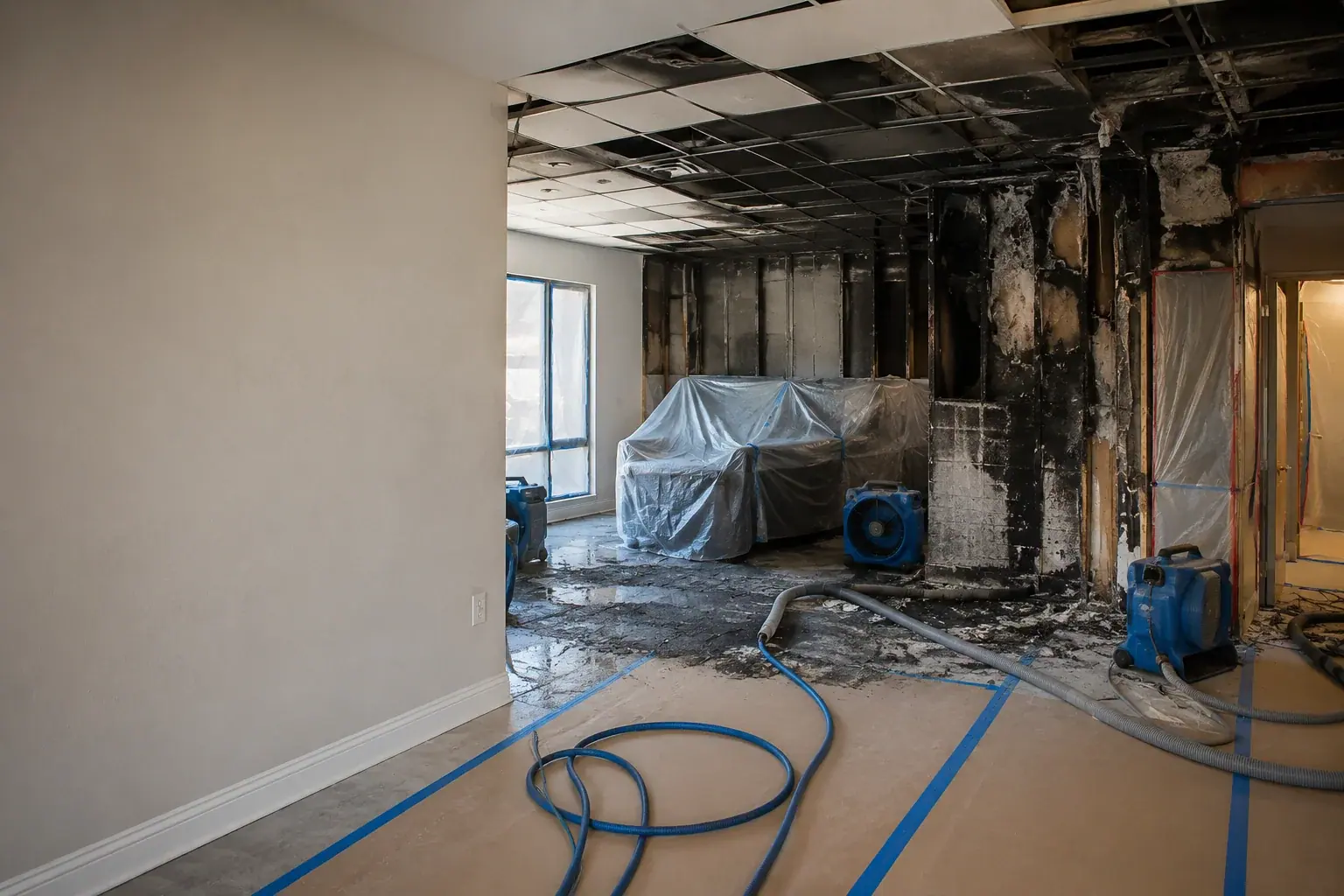
Firstline isolates the burn area, removes firefighting water, records residue and odour routes, and protects unaffected levels. Contents are triaged before demolition blocks access. Where a fire involves an attached row or condominium, common roofs and separations are checked so smoke or water in the neighbouring unit is not missed simply because flame remained elsewhere.
Meadowlands and Garner Bring Denser Housing
Ancaster is still associated with detached homes, but its official plans provide townhouses, medium-density sites, and condominium apartments across several Meadowlands and Garner areas. One site at 1117 Garner Road East permits a nine-storey condominium. Water in these properties can cross common roofs, stacked plumbing, parking areas, and unit boundaries. Firstline protects corridors and elevators, assigns every measurement to its suite or shared assembly, and coordinates access with management. In a townhouse row, party walls, connected attic spaces, attached garages, and private roads shape the work. The restoration file remains useful while corporation, unit-owner, builder, and insurer roles are still being sorted.

Business Park Losses Depend on Process and Product
Ancaster Business Park supports almost 4,000 workers in advanced manufacturing, life sciences, food and beverage production, and warehousing. Tim Hortons' Canadian roasting operation, Stackpole, and Sunrise Records' headquarters illustrate the range. A restoration response begins by identifying shutdown authority, utilities, safe traffic routes, protected stock, and production zones. Food or beverage work requires separation between clean operation and the affected area. Machinery may need a manufacturer or technical specialist before power returns. Firstline handles building extraction, cleaning, drying, controlled removal, and repair while keeping process equipment and product disposition in the operator's decision chain. Loading schedules and Highway 403 access are built into staging.

Redeemer, Schools, and Seniors Properties Need Occupancy Planning
Redeemer University's 83-acre campus accommodates more than 1,100 students and combines teaching, residence, assembly, food, office, and recreation spaces. Ancaster also has schools, churches, retirement settings, clinics, and clubs. These properties require more than a room-level drying plan. The operator identifies critical routes, vulnerable occupants, class or meal schedules, and areas that cannot share air or traffic with restoration work. Firstline establishes containment, equipment paths, noise windows, and daily updates around those needs. A residence leak is recorded by room and common area, while a kitchen or institutional mechanical loss may require further health, engineering, or equipment review before reopening.

Storms Combine Canopy, Elevation, and Open Rural Roads
Above the Escarpment, winter wind, snow, freezing rain, and rapid freeze-thaw can affect roofs, overhead branches, plumbing, and access at the same time. Shaded valley roads retain ice while open roads near Jerseyville or Alberton can drift. Heavy rain raises watercourses and pushes runoff toward culverts and low crossings. Hamilton Conservation Authority monitors Ancaster Creek at Wilson Street and the wider Spencer system. Firstline documents roof or tree openings before temporary cover, checks the vertical moisture route, and plans backup power or heat with electrical and mechanical safety. Rural mobilization includes enough equipment and containment to reduce avoidable return trips.
How an Ancaster Restoration Project Progresses
- Verify location and services. The call record identifies village, suburban, business-park, or rural conditions, along with central water or private systems.
- Make entry safe. Active leaks, contamination, electrical risk, smoke, unstable material, and weather exposure receive immediate controls.
- Follow the building and grade. Readings, photographs, floor relationships, and creek or slope context establish how damage spread.
- Separate clean operation. Occupied rooms, contents, production areas, corridors, and access routes are protected.
- Remove and dry to evidence. The method changes with material, contamination, and monitoring rather than a fixed equipment count.
- Resolve specialist questions. Heritage, well, septic, fuel, machinery, structural, and environmental issues enter the scope where relevant.
- Rebuild from the same record. Permanent work connects to the original source and verified removal boundary.
Documentation Across Household and Business Claims
Firstline records observed source, emergency protection, affected areas, readings, cleaning, demolition, contents handling, and repair needs. At a rural address, that may distinguish building water from a well, septic, or fuel-system problem. In the business park, it can separate the damaged envelope from operator decisions about product or machinery.
The insurance carrier applies policy coverage and limits. Firstline can supply the adjuster with the physical-loss file and offer direct insurer billing when approved. Any deductible remains due from the owner, as does the cost of elective upgrades or excluded work. No restoration contractor can decide policy coverage by inspecting the building.
Access Changes Between Highway, Village, and Rural Sites
Highway 403 is the main GTA approach. Wilson Street, Golf Links Road, Highway 6, Garner Road, Fiddler's Green Road, Southcote Road, Book Road, and Trinity Road distribute traffic. A Cormorant Road loading dock provides direct equipment access; a Wilson Street storefront may have only a rear lane; a valley house may sit below the road; and a farm entrance may not support heavy vehicles after rain. Firstline confirms the final approach, turning space, floor protection, hose distance, electrical supply, and waste route before the work zone is built. Escarpment grades and highway congestion are treated as logistics, not as reasons to dilute the required response language.
One Team Across Ancaster's Different Systems
Ancaster Property Damage? Call Firstline.
Keep people clear of contamination, active smoke, unsafe structure, and any water beside electrical service. Call (416) 900-3508 and identify whether the property is urban, rural, multi-unit, institutional, or industrial.
Mention a well, septic system, fuel tank, creek, steep access, or operating production area so the first response can account for it.
Need restoration in Ancaster now?
Talk to Firstline Restoration, 24/7 emergency response, insurance claim support, and full reconstruction.
Companies We've Worked With
Trusted by Leading Organizations
Firstline Restoration serves commercial, institutional, and property-management clients across the GTA.










Ancaster Restoration Services FAQ
Do all Ancaster properties have municipal water and sewer?
No. Urban areas are centrally serviced, while rural properties may use wells, cisterns, and septic systems. The address and actual utilities are confirmed during scoping.
Why does the Escarpment matter?
Ancaster and Tiffany creeks cross Escarpment terrain toward Sulphur and Spencer creeks. Slopes, groundwater, culverts, runoff, and winter grades affect water routes and access.
Can Firstline work with old stone and plaster?
Yes. Condition, contamination, attachment, moisture, and drying access are recorded before deciding what can remain and what needs selective removal.
Do you handle the Ancaster Business Park?
Yes. Building restoration is coordinated around utilities, loading, production, product, and equipment-review authority specific to the operator.
Can you restore condominiums and townhouses?
Yes. Suites, common elements, party walls, roofs, corridors, garages, and resident contents receive separate records.
How does direct billing work?
It may be arranged when the insurer approves it. The policy decides coverage, and the property owner pays the deductible.
What should I say during an emergency call?
Give the address, source, affected areas, building use, utility type, occupant concerns, and any rural access, creek, fuel, or industrial condition.
Request Restoration Services in Ancaster
Firstline answers 24/7/365 for emergency stabilization, cleanup, claim records, and reconstruction.
Request Help Now
Calling is fastest for active emergencies. 45-min emergency response · free assessment · we work directly with your insurance.
Restoration Near Ancaster
View all service areas →Firstline Restoration provides 24/7 emergency response for restoration across Toronto and surrounding Ontario communities.